For the past six months, lumbering in state forests was under a moratorium while the Climate Forestry Committee reviewed new research and policies from various viewpoints regarding forest practices. The moratorium has now ended. In light of the potential of our state’s forests to provide carbon sequestration naturally, new recommendations for forest management guidelines are now available at https://www.mass.gov/info-details/forests-as-climate-solutions. The full report of the committee can be found here.
Most importantly, they are seeking public input at this shared comments link. We encourage you to voice your opinions and thoughts as soon as possible about these new recommendations for forests and their role in carbon sequestration. The deadline for comments is January 24th, 2024.
Our thought is that the recommendations are a positive step, yet are still ambiguous, and are not strong enough in maximizing the use of our public forests to sequester carbon. We encourage you to voice your own opinion by Jan. 24th.
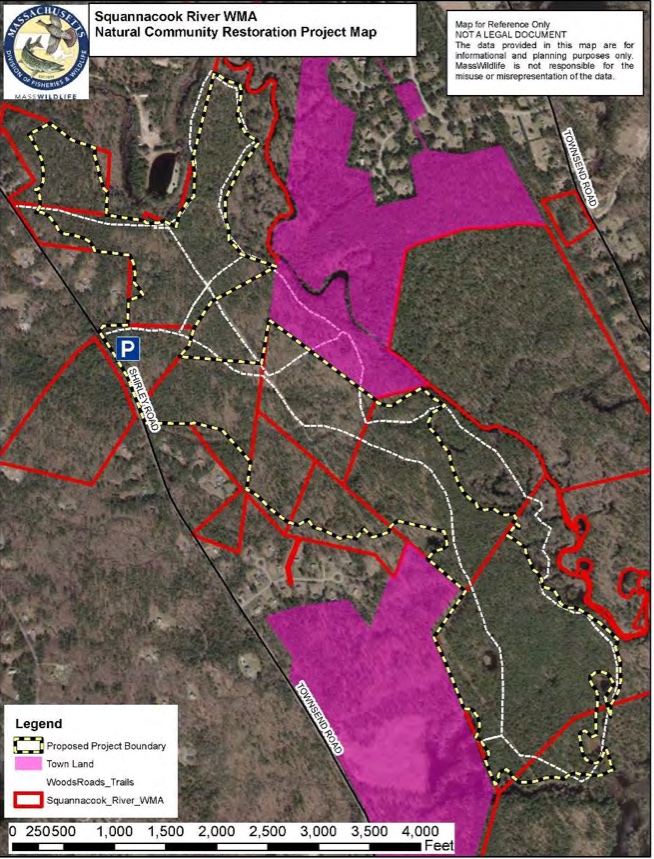
Mass Fish and Wildlife is seeking permission to convert about 1800 acres of their land off Shirley Road in Townsend and Shirley into an oak barrens. The plan is for the initial phase of work to cover approximately 215 acres, as shown in the maps at the bottom. This conversion would be accomplished through clearing the forest of all trees except the larger oaks. It would all require repeated tree and brush cutting, yearly application of herbicides, and frequent prescribed fires. While diverse habitat is a worthy cause, we are concerned about the significant negative impacts of such a conversion. These include:
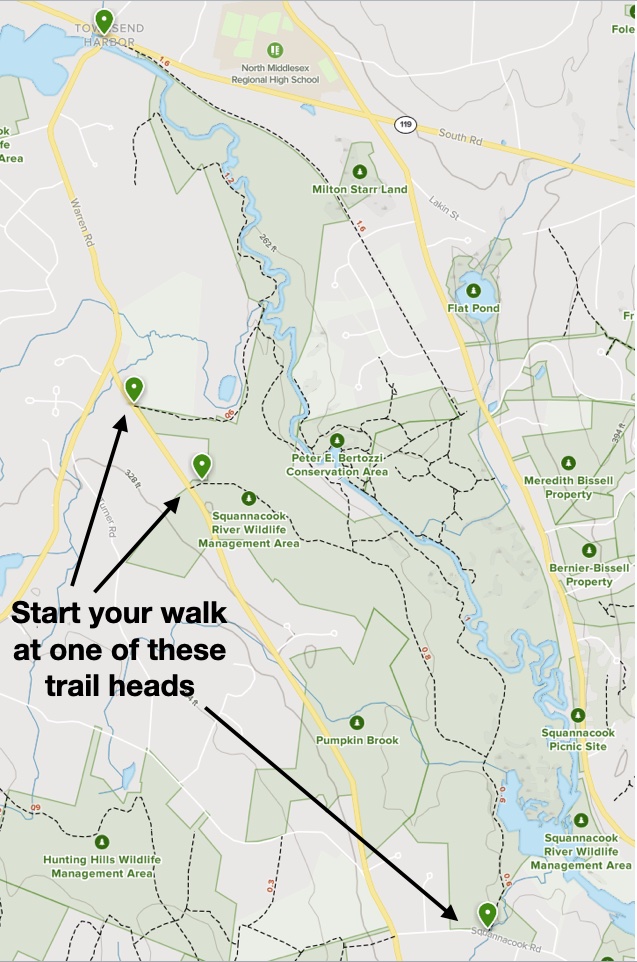
We encourage everyone interested to take a walk there, and see for yourself - see the trail map at the bottom. Only the few few oak trees with red circles will be spared - the vast majority will be removed.
Read the detailed permitting application here.
Read Fish and Wildlife’s reasoning for the project here
To support Maura Healy's pledged one-year moratorium on lumbering on public lands in Massachusetts to better study this issue, please sign the on-line letter of encouragement by Dec. 16, 2022.
Let your opinion be known on whether this project is worth these costs, write State Senator John Cronin at john.Cronin@masenate.gov or any other state official in the area. See a sample email here.
Stay tuned for more details. We will announce all public meetings and site walks.
Below are two pictures from the Muddy Brook Wildlife Management Area in Harwick, MA. The first is right after lumbering. The second is after about five years of active management.
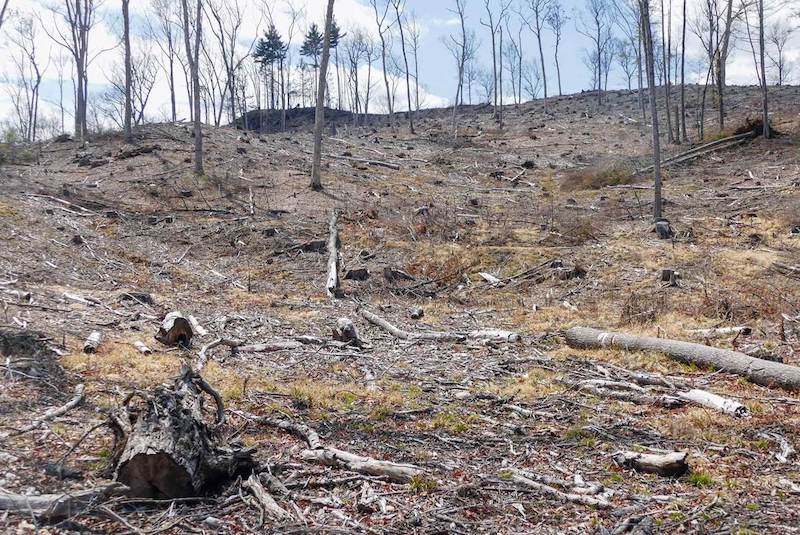
Muddy Brook WMA after nearly clearcut lumbering.
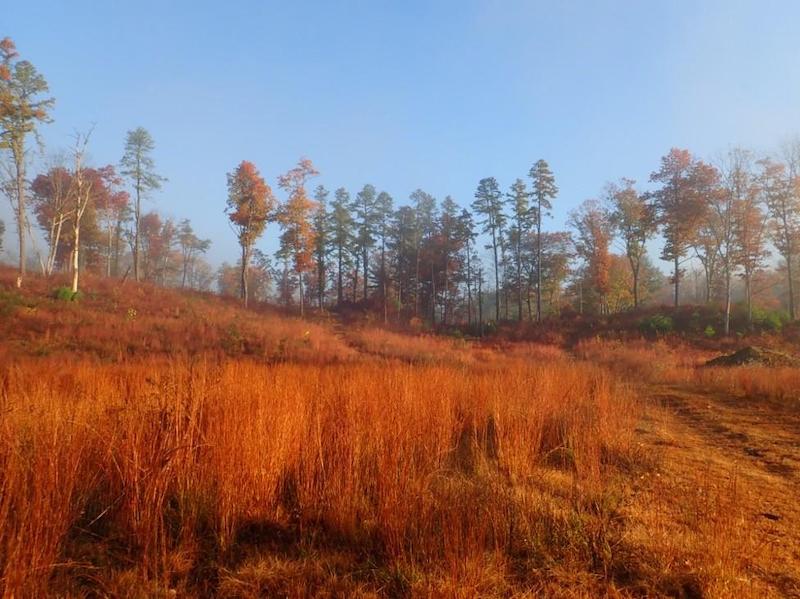
Muddy Brook WMA about five years after, including multiple prescribed burns.
One issue at the heart of the debate about the future of Squannacook Forest is the tradeoff of two environmental concerns: our warming planet versus biodiversity. A decade ago when Fish and Wildlife starting planning for this oak barrens project, it was believed that forests captured most of their carbon when they were young. The general assumption was that forests that were over 60 years of age, as is Squannacook Forest, only sequestered diminishing amounts of carbon. For this reason, people saw that planting new trees was one of the most effective ways to absorb carbon from the atmosphere, rather than preserving older forests.
However, the careful scientific research in the past few years has turned this idea on its head - older forests have now been found to absorb at least as much carbon per year as younger ones. Some studies have even found that forests increase their yearly uptake of carbon by a factor of two or more after they reach the age of Squannacook Forest. On the other hand, a forest with seedlings will take decades before it becomes a serious carbon sink.
These discoveries have led to the notion of Proforestation, which is simply advocating for leaving older forests alone, letting them absorb carbon at ever increasing rates. Proforestation is now accepted as the most efficient use of North American land to absorb carbon on a per acre basis. You can hear one of the leading scientists in the field, William Moomaw from Tufts University, discuss Proforestation in our area in the video at https://vimeo.com/368579793. The whole talk is worthwhile, but the Proforestation section begins at 37:30.
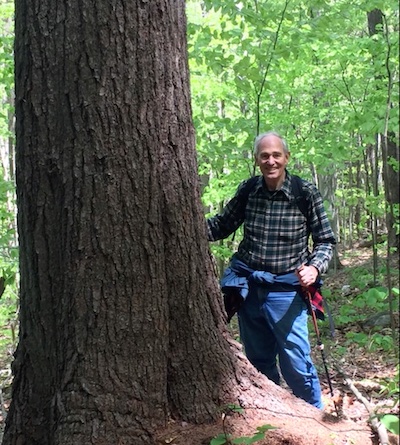
Click the image above to see the video. You can slso read a scientific article by William Moomaw on this topic.
A straightforward way to increase oak barren acres in Massachusetts without having such a large carbon impact would be to focus on open land or on very young forests. According to the research, these trees would take decades before they would become efficient carbon absorbers. We strongly recommend these open lands and new forests be the home of biodiversity efforts, providing a better trade-off of these two environmental concerns.